Focal Length Explained: From Wide Angle to Telephoto
More Than Just "Zooming In"
When you buy your first camera, the lens usually has a set of numbers printed on it, like "18-55mm." Most beginners understand that if you twist the lens to 18mm, the camera zooms out, and if you twist it to 55mm, the camera zooms in. This is true, but thinking of focal length as nothing more than a pair of digital binoculars is a massive mistake.
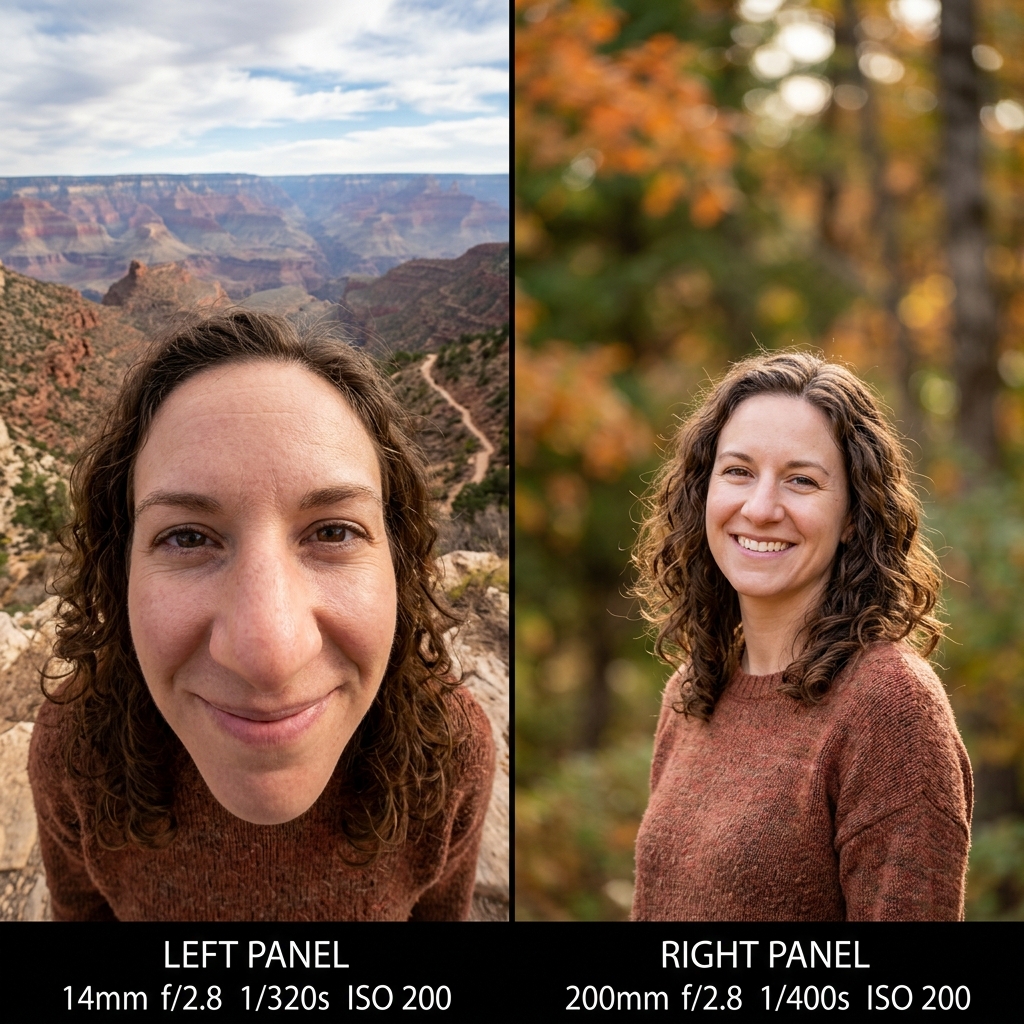
Focal length does much more than just make things bigger or smaller in your frame; it fundamentally changes the physical properties of the image. It alters the perspective, distorts reality, and changes how the background interacts with your subject. I learned this the hard way when I tried to take a flattering portrait of a friend using an ultra-wide 14mm lens. The resulting photo made her nose look twice its actual size and her ears disappear behind her head. She was furious, and I learned a vital lesson: choosing the right focal length is a creative decision, not just a matter of convenience.
The Wide Angle Lens (14mm to 35mm)
Wide-angle lenses are designed to capture a massive field of view. Because they pull in so much of the scene, they naturally "push" the background away, making everything look incredibly expansive and vast.
When to use them: Wide-angle lenses are the undisputed king of landscape and real estate photography. If you are standing on the rim of a canyon, a 16mm lens will capture the sweeping majesty of the entire gorge. If you are photographing a tiny apartment for a real estate listing, a wide-angle lens will magically make a cramped 500-square-foot room look like a spacious luxury loft.
The Danger: Distortion. The wider you go, the more the lens distorts reality, especially near the edges of the frame. Straight lines will begin to curve (known as barrel distortion). If you place a person close to the camera with a wide-angle lens, whatever body part is closest to the lens (usually their nose) will appear comically enlarged. Never use a wide-angle lens for close-up headshots unless you are intentionally trying to create a funny, cartoonish caricature.
The Standard "Nifty Fifty" Lens (50mm)
The 50mm lens holds a legendary status in the photography world. It is often referred to as the "Nifty Fifty" because a 50mm focal length on a full-frame camera roughly matches the natural field of view of the human eye.
When you take a photo at 50mm, there is almost zero distortion. The image feels incredibly natural and authentic to the viewer, as if they are standing right there in the room with you. It doesn't stretch the background like a wide-angle, and it doesn't compress the background like a telephoto. Because 50mm lenses are cheap to manufacture, you can easily buy a 50mm f/1.8 lens that produces gorgeous, professional background blur for a fraction of the cost of a zoom lens. It is the perfect focal length for street photography, documentary work, and casual lifestyle portraits.
The Telephoto Lens (85mm to 200mm+)
Telephoto lenses are essentially telescopes. They have a very narrow field of view, which allows you to zoom in on distant subjects. However, their true superpower is something called "Lens Compression."
When you zoom all the way in with a 200mm lens, the lens physically compresses the distance between your subject and the background. Imagine a person standing a mile away from a mountain. If you shoot them with a wide-angle lens, the mountain will look like a tiny, distant hill. But if you walk a hundred yards backward and zoom in with a 200mm lens, the mountain will appear to be pulled dramatically forward, looming massively directly behind their shoulders.
The Ultimate Portrait Tool: Lens compression is incredibly flattering for the human face. It slightly flattens the facial features, making noses look proportionate and faces look thinner. Furthermore, because you are zoomed in so far, the background behind the person completely blows out into a soft, creamy wash of colors (bokeh). If you want to shoot professional-looking portraits that make people gasp, throw away your wide-angle lens and start shooting portraits between 85mm and 200mm.
Choosing Your Weapon
The next time you go out to shoot, don't just stand in one spot and twist your zoom lens back and forth until the subject fits in the frame. Make a conscious choice. Do you want to show the vastness of the environment? Put on a wide-angle lens and get extremely close to your subject. Do you want to isolate a detail, flatter a face, or make a distant background look massive? Put on a telephoto lens and walk backwards. Master focal length, and you master reality.


Comments
Post a Comment